Product page audit: is your page arguing with itself?
A product page audit usually hunts for what is missing. The costlier problem is two lines on the same page that disagree, and it is usually two correct edits made on different days.
In this piece
A useful product page audit checks what the page says twice. Missing information costs you a sale. Two lines that disagree cost you the reader's trust in every other line, and that's the bigger leak.
Most audits hunt for gaps. Is there a size chart, a shipping policy, a review count? Those checks are worth running. They just miss the finding I put first on the last product page I audited.
What does it look like when a page argues with itself?
This summer I audited a one-product drink brand. On the first screen, the banner said “We're sold out.” The hero, a few inches lower, said “Ships same day.”
Both lines were true once. Someone wrote the hero when the product was in stock. Someone added the banner when it wasn't. The hero didn't get updated.
And every buy button on the page led to the one option that couldn't happen.
A contradiction usually isn't a mistake anyone made. It's two correct edits, made on different days, by different people.
Why is a contradiction worse than a gap?
A gap sends the reader looking. A contradiction makes them wonder what else is wrong.
If the shipping line is wrong, is the guarantee? Is the price? The reader can't check, so the careful ones leave. The rest buy with less confidence than they arrived with.
Machines read the page too, and they're less forgiving.
Google Merchant Center compares the availability in your product feed with what your landing page says. Its help page on mismatched availability is blunt. The two “must be the same.” Products that don't match get disapproved from ads and free listings, and too many can lead to account suspension.
Google Search has a matching rule for structured data. Its guidelines say your markup “must be a true representation of the page content.” If your schema says 4.9 stars and the page says 4.7, one of them is wrong, and Google has no way to know which one you meant.
Then there are answer engines. When ChatGPT or Perplexity reads your page, it gets two answers to one question. Whatever it does next, you've lost control of which answer reaches the customer.
Where do contradictions usually hide?
Start with these 5. They're the places where edits pile up, because they change more often than anything else on the page.
- Stock and shipping. “Sold out” in one place, “ships today” in another. A preorder date that has already passed.
- Price. The hero says $49. The bundle card works out to a different per-unit price than the table below it. Subscription savings quoted as 15% in one section and 20% in another.
- Ratings and review counts. A hand-typed “4.9 stars from 2,000 customers” in the hero, and a live widget from Judge.me or Okendo showing something else further down.
- Guarantees and policies. A 30-day guarantee in the hero, 60 days in the FAQ, and 14 days in the refund policy you actually enforce.
- Dates and “new” claims. “New for 2025” reads very differently in 2026, and the edit that removes it rarely gets scheduled.
How do you run a contradiction audit?
You need a phone, a blank document, and about 30 minutes for one product page.
- Open the page on your phone, logged out, the way a stranger sees it.
- Copy every factual claim into the document, one per line. Prices, numbers, dates, promises, stock status. Skip the adjectives. “Delicious” can't contradict anything.
- Sort the lines by subject. All the price lines together, all the shipping lines together.
- Any subject with 2 different versions is a finding.
- Now follow the buyer. Add to cart, go to checkout, open the FAQ and the footer links. Claims keep changing after the product page, and the cart is where a customer notices.
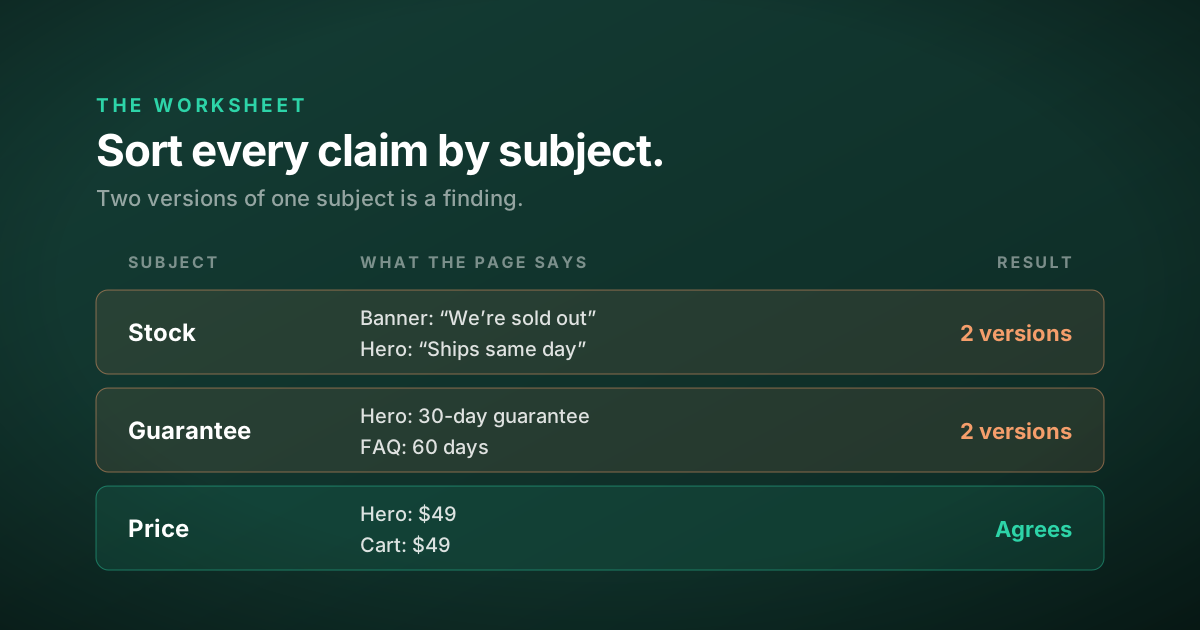
Write each finding as the two lines side by side, not as a note. “Banner: sold out. Hero: ships same day.” That's the version a busy founder will actually fix, because it proves itself.
The fix is one source, not a better sentence
The tempting fix is to correct the wrong line. That works until the next edit.
The fix that lasts is giving each fact one home. On Shopify, that usually means a metafield for the value and a section that reads from it. Your guarantee length lives in one place, and every section that mentions it pulls from there. Change it once and the page can't disagree with itself on that fact.
Stock is easier still. Shopify's Liquid has a product.available property that returns true when at least one variant is in stock. Wrap the “ships same day” line in a check against it, and the line disappears the moment you sell out.
It's the same point I made about what makes a Shopify theme easy to change. One source for every number is a structure decision. You make it once, and then it keeps paying.
When is a contradiction audit the wrong tool?
Not every difference is a contradiction. The exception is a comparison. A sale price next to the regular price is doing its job. A subscription price under a one-time price is the same thing. Leave those alone.
There's a catch, though. It won't rescue a weak offer. A page that agrees with itself perfectly can still sell the wrong thing to the wrong person. This audit fixes trust, not demand.
And it doesn't scale by hand. Past a few dozen products, you want the product issues Merchant Center reports and a crawler, not a phone and a document. My free Findability Check reads your page the way machines do. Reading for two lines that disagree is still a job for a person.
One question
Open your product page and find the first number on it. Now find everywhere else it appears.
Do they all agree?
Questions people ask
What is a contradiction audit on a product page?
It is a product page audit that looks for claims made twice in different versions, rather than for missing information. You copy every factual claim on the page into one list, sort the list by subject, and flag any subject with two versions. Stock and shipping, price, ratings, guarantees and dates are where contradictions usually hide.
Why is a contradiction worse than missing information?
A gap sends the reader looking for the answer. A contradiction makes them doubt every other claim on the page, because they cannot tell which version is true. Machines are stricter still. Google Merchant Center disapproves products whose landing page availability does not match the product feed, and Google Search requires structured data to be a true representation of the page content.
How long does a contradiction audit take?
About 30 minutes for a single product page, with a phone and a blank document. Past a few dozen products it stops scaling by hand, and you want the product issues Merchant Center reports plus a crawler instead.
How do I stop a Shopify product page contradicting itself?
Give each fact one home. Store values like a guarantee length in a metafield that every section reads from, so a change happens once. For stock, wrap shipping promises in a check against the Liquid product.available property, which returns true when at least one variant is in stock, so the line disappears when you sell out.